-
Orvieto Funicular, Italy유럽_Europe/이탈리아_Italy 2026. 4. 1. 20:46
Orvieto is a city where ascent comes before arrival.
Even the railway station name, Orvieto Scalo, tells you so: it is the lower station. The “real” Orvieto we imagine — the old town itself — sits high above on the cliff-top upper city. That is why any visit to Orvieto begins not simply with arriving, but with going up. And the most characteristically Orvieto way to begin that first scene is by taking the funicular.
It makes one wonder: before the funicular was built, how did people make their way up to such a high city?Orvieto Funicular(Cable Railway)
After parking our hire car in the open public car park below the cliff and looking up, Orvieto immediately felt like a city that tests people. It is not a city laid out on flat ground, but one that seems to have placed itself upon a cliff of volcanic tuff. Today, the funicular allows visitors to reach the upper town comfortably in just a few minutes. But before that, the people of Orvieto had to rely on steep roads, winding slopes, and horse-drawn carts laden with goods to move up and down this height. Some must have carried daily necessities; others would have gone down to market and then climbed all the way back up again. In Orvieto, going up was never just a matter of transport. It may well have been part of the city’s way of life for centuries.
Cross the square in front of the car park and the lower funicular station appears almost at once. Once the doors close and the carriage begins to move slowly up the incline, the view below gradually falls away and your gaze is naturally drawn towards the city above. In that moment, you realise that Orvieto is not a place that begins when you arrive, but a place that truly begins as you ascend.

View of the cliff-top old town from in front of Orvieto’s lower funicular station 
Following the Orvieto funicular tracks as they climb towards the city above Why take the funicular at all?
There are several ways to get up to Orvieto. You can take a bus, a taxi, or simply drive all the way up. And yet we parked our hire car in the large public car park and chose the funicular instead. It was partly because the open-air car park was spacious and convenient, but there were also very clear reasons why I would recommend taking the funicular.
First, because the journey itself becomes part of the experience.
The funicular is not merely a convenient means of transport; it helps you understand the topography and character of Orvieto with your whole body. This is not a town built on level ground, but one set high upon a tuff cliff. The funicular makes that difference in height immediately tangible. In fact, the vertical difference between the lower station area and the old town is said to be about 157 metres.Secondly, because it is short enough to feel effortless while still preserving a sense of romance.
The official and tourist information usually describes the journey as taking around five minutes each way, and in reality it did feel over almost at once. Without changing your plans in any major way, it turns your entrance into Orvieto into something much more memorable.Thirdly, because it leaves you at exactly the right gateway to the old town.
The upper funicular station emerges near Piazza Cahen, and from there your walk through Orvieto properly begins. Pozzo di San Patrizio, St Patrick’s Well, is also very close by, so it makes perfect sense as a first stop.Before taking the funicular down again at the end of the day, we stopped first at St Patrick’s Well. We went down the 248 steps leading into the well and then climbed back up again, which meant covering nearly 500 steps altogether. Going down, I was struck by the ingenuity and elegance of the Renaissance structure. But by the time we reached ground level again, my legs felt rather heavy and I could sense my energy beginning to fade.
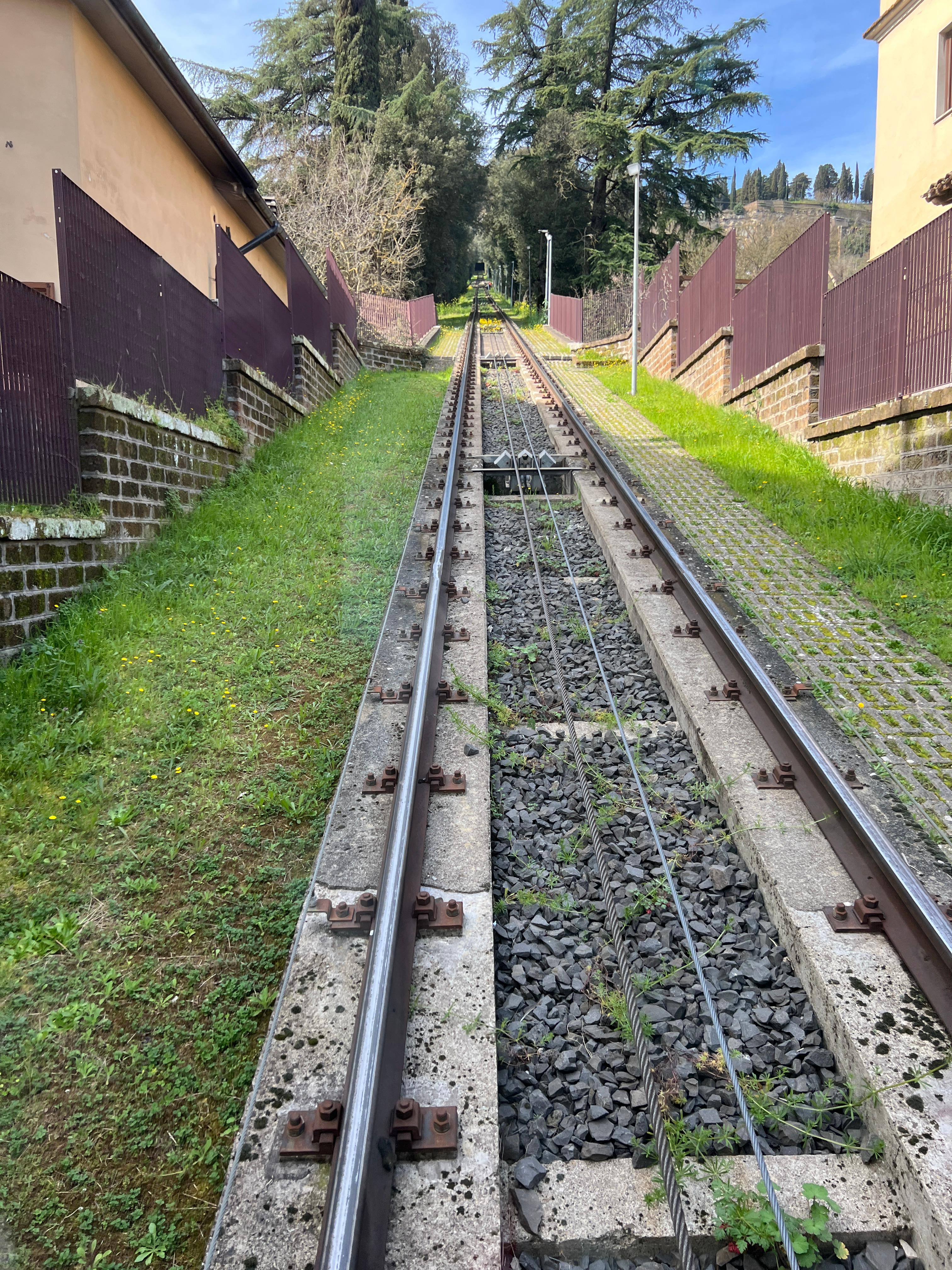
View of the lower funicular track — the ascending line leading towards the cliff-top old town What makes this funicular special
Whenever I travel to a new city, I tend to ride its funicular if there is one. There is something about going up high and looking out over a new place for the first time that always lifts my spirits. What made the Orvieto funicular even more interesting was that it is not simply a modern piece of transport infrastructure, but something that continues an older urban wisdom.
The first line was built in 1888, and it is said to have operated at the time using a water-balance system.
Service was later suspended in 1970, but in 1990 the line was rebuilt along the same route and reopened in electric form.
Looking down at the line from inside the Orvieto funicular 
The moment the carriage crossed paths with the one coming the other way Layers of time
I liked that sense of layered time. On the surface, it is a neat and modern cable railway, yet the line itself follows a route that has connected the upper and lower parts of the city for well over a century. Orvieto is a city on a cliff, while the station lies below. The difference in height between Orvieto Scalo and Piazza Cahen is around 157 metres. So this short ride is not merely a transfer from one point to another, but a way of physically understanding the city’s structure.
The Orvieto funicular entering the tunnel beneath the city walls
Another striking feature is that, as the line nears the top, it passes through a tunnel cut through the city walls. Just before entering the upper town, you pass briefly through darkness, and it feels almost as though you are crossing a threshold into the city itself. For me, the Orvieto funicular was not simply a way of climbing a hill, but a memorable entrance into the old town.
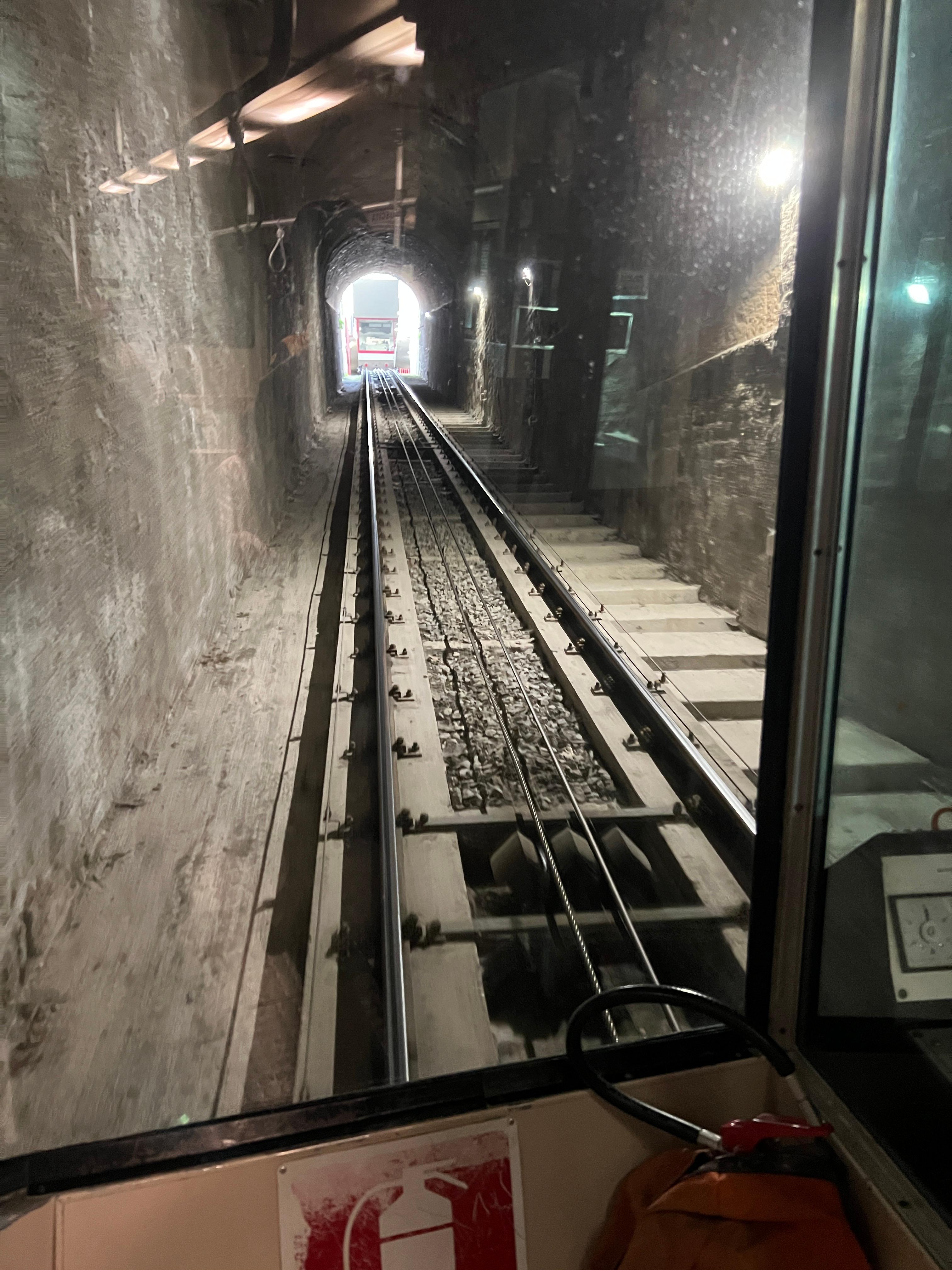
Passing through the tunnel beneath the walls A landscape that changes in five minutes
As the funicular begins to move, the railway station and the lower town gradually shrink away like a miniature model. Beyond the window, the Umbrian plain opens out, and you suddenly understand with your own eyes why Orvieto is called a city on a cliff.
What I liked about this short ascent was that it naturally shifted my state of mind into what I can only call “old-town mode”. Only moments before, I had simply been someone in transit. Within five minutes, I had become someone eager to wander through old lanes on foot. That change was so intriguing that my first impression of Orvieto has remained especially vivid.

The moment the funicular arrived at the upper station Practical tips for planning your route
The funicular generally runs about every ten minutes on weekdays. However, frequencies and opening hours may vary depending on the season or public holidays, so it is wisest to check the day’s timetable on site. The service is commonly listed as operating from 7.15 am to 8.30 pm on weekdays.
Once you reach the upper station at Piazza Cahen, you can either walk into the historic centre towards the Duomo or continue by local bus. Tourist information suggests beginning your walk along Corso Cavour from Piazza Cahen, or taking a town bus towards Piazza del Duomo or Piazza della Repubblica.
We chose not to take the bus and spent the whole day walking instead. There were so many unexpected corners and curious details tucked away in the lanes that I felt Orvieto is best appreciated on foot, at a gentle pace.
Suggested route
Arrive at Orvieto Scalo station → take the funicular → arrive at Piazza Cahen → visit St Patrick’s Well if possible → stroll along Corso Cavour towards the centre → continue on towards the Duomo
If you are visiting Orvieto by car, it is worth parking in the large public car park right in front of the funicular station and taking the funicular up from there. When we visited, parking was free.
Closing thoughts
Orvieto is a city that has already begun by the time you are going up. That is why the funicular felt to me not merely like a convenient means of transport, but like the opening sentence that best captures the city’s identity.
And I care deeply about first sentences when I travel.
For me, the first sentence of Orvieto was that brief five-minute ascent: crossing the square outside the station, stepping onto the funicular, and beginning to move slowly towards the cliff-top city.The full story of my Orvieto journey continues in the post below.
Orvieto, Italy — travel diary: https://83-invisible.tistory.com/404Memory walks through landscapes, and becomes story.
– Nomadia83, at the end of a journey#ItalyTravel #CentralItaly #HistoricTown #OldTownWalk #HilltopTown #CliffTopCity #CableRailway #ItalianGetaway #HiddenItaly #TravelDiary #WalkingTour #SlowTravel #EuropeanTravel #ItalyHiddenGems #83invisible
728x90반응형'유럽_Europe > 이탈리아_Italy' 카테고리의 다른 글
이탈리아 오르비에토 푸니콜라(경사 철도) (0) 2026.04.01 로마 스페인 계단(Spanish Steps) — 스파냐 광장 포토스팟 + 주의사항 (0) 2026.03.12 로마 보르게세 미술관(Galleria Borghese) (1) 2026.03.04 이탈리아 로마 팔라티노 언덕 (Palatine Hill): 로마가 처음 도시가 되기 시작한 자리 (0) 2026.03.03 이탈리아 로마 포로 로마노(Roman Forum) — 고대 로마의 심장 (0) 2026.03.03